The Development of Welcome to Promise
2026 / 07 / 13
Bonjour, investigators! Once again it’s Keith Ryan Kappel, one of Edge Studio’s freelance game writers. Today I’m feeling finer than frog hair as it is my great pleasure to interview the great Leah Hawthorne about the production of the Welcome to Promise starter set for Arkham Horror: The Roleplaying Game. Leah served as the primary writer and developer on the project, with help from Christopher Hunt.
In the event you’ve been lost chasing Feux Follets in the bayou, and this is the first you’ve heard tell of a new starter set for Arkham Horror: The Roleplaying Game, allow me to catch you up. We announced Welcome to Promise earlier this year and later explored the contents included in the box in some detail. We also read a letter from the singer with a “Smoky Velvet” voice, Marie Lambeau, written to her friend Mandy Thompson about some nasty critters to watch out for in the bayous of Louisiana.
With all that behind us, I know you have questions enough to fill a gumbo pot. So, let’s get some answers straight from the source!

Keith Ryan Kappel (KRK): So, Leah, congratulations on Welcome to Promise, and also, welcome to this interview! I’ve had the opportunity to read through the new starter set and it’s not just a wild ride of an adventure, it’s also a really great introduction to the system for new players and game masters. Of course, perhaps the most exciting bit is that it all takes place in the 1920’s Louisiana of Arkham Horror.
How exciting was it to move the mythos out of the cold New England region and explore such a cultural and environmentally distinct place?
Leah B. Hawthorne (LBH): Hi Keith! Thank you so much, I know Chris and I really appreciate it. I’ll say that I was very, very excited to go south with this latest starter set. Louisiana has such an interesting history, and many of the different parishes and cultural groups have their own folklore that was pretty fun to research and explore. It’s funny, I feel like 80% of the research for various regions and products won’t end up getting used, but that 20% that does get used usually comes from digging into one topic to the next from a totally random starting point. It’s one of my favorite parts of writing—having the opportunity to deep-dive into different places and learn a bunch of random fun facts and tidbits. It makes for a great ice-breaker at parties, ha! I loved looking into cryptids, Louisianan voodoo, Creole and Cajun culture, local wildlife and, I admit, learning the differences between bayous, swamps, bogs, and marshes!
There are, of course, NPC profile cards (20) as with our previous boxed experiences—but this time around we also include a new tool to track enemy dice pools. The new small, square tokens can be placed on the square section of the dice tracker cards, each numbered to correspond with a circular complementary version for the battle maps. This way, several NPC’s dice pools can be easily tracked on one sheet. With the dice tracker cards, a GM can quickly identify that an investigator shot Corpse Gator 1 and properly adjust that enemy’s dice pool without having to remember which gator is which! With the dice trackers, GMs will only need one copy of the enemy’s profile card, which leaves room for more characters in the box!
KRK: I was really impressed with how well the adventure balances a great story with teaching the rules, and how quickly you’re able to get new game masters and players into gameplay. Of course, I remembered that this isn’t the first starter set for the Arkham Horror: The Roleplaying Game, there’s of course the Hungering Abyss starter set.
What motivated you and Edge Studio to produce a second starter set for a relatively young game line? What separates this starter set from Hungering Abyss?
LBH: There are a lot of factors that go into deciding what products to make, and from the beginning of our development of the Arkham Horror RPG we knew we’d want to create multiple entry-points for players. It’s both a move to appeal to new players and game masters, but it’s also another way for us to offer stories to existing players, too. Just because this is a starter set doesn’t mean the story itself isn’t a cool experience you can use with your existing campaign or with seasoned players.
We also wanted to take what we learned with Hungering Abyss and make changes based on what we saw could be improved and what we were hearing from fans. I tend to lurk in various forums and keep an ear out for what people are struggling with and I’ve tried to take that information and make adjustments to improve player and game master experiences. We might not always get it perfect, but the folks at Edge are always trying to innovate and create quality products.
I won’t try to list everything that’s different, but a few highlights are a larger adventure booklet so we could include more content and possibilities in the narrative. I also revamped the teaching element of this box versus how I approached it in the first starter set, breaking the learn-to-teach into three segments with the big highlights, each leading into a scene to apply that new knowledge, and included references to additional information in the new rules appendix.
The appendix is a 16-page booklet gives a run-down of the rules of the game, can help answer any questions that come up in play in a more intuitive way than trying to flip through the adventure booklet frantically. We also wanted to create this rules appendix so GMs could use it across their games, increasing the value of this starter set for GMs even if they aren’t interested in this specific story. We tried to do that with various components this time around, including some injury and trauma reminder cards, new dice-tracker sheets for tracking multiple NPC dice pools simultaneously, and Pool Die tokens to track available dice in a player’s or NPC’s dice pool when there aren’t enough physical dice available.
KRK: This starter set is packed full of accessories. It has gorgeous maps, handy weapon and equipment cards, fearsome and friendly NPC cards, and great quick-reference sheets for rules and injuries and clues and more.
When you’re creating all these accessories, do you find it’s difficult to narrow the choices down? What makes for a good battle map? How do you fit a whole interesting character on a single NPC card?
LBH: Woah, a few rapid-fire questions there that all deserve their own answers. When we’re looking at what components to include in a box, it’s definitely a lot of back and forth. There’s obviously the production end where we ask, “What is possible?” and “If we include this, will it force us to change how much we charge for the product?” I can’t go into details about any of that, but there is a lot of discussion for all of our products across all of our lines about everything from the amount of pages we can include in a book to what we can include in a box.
Then you have the other important questions, “How does this additional serve the game master and player?” and “Does this make things easier, cooler, or more immersive?” and weighing all of the options. You wouldn’t think adding 16 pages to a book or adding 10 more NPC cards would be that big of a deal, but we have to think about the weight of the products for shipping, whether there is a minimum number of cards we’d have to add (if the printer has minimum requirements) and if we have useful, cool content to fill all of those cards.
From the development side, I always want to add more. My editorial manager, Croc (who is also one of the founders of Asmodee and has been working on RPGs for 40+ years), always tells us to think big and bold, and then it’s his job to hash things out with production to see what is possible. I think it boils down to: what’s possible, what’s cool, what’s useful, and what’s required?
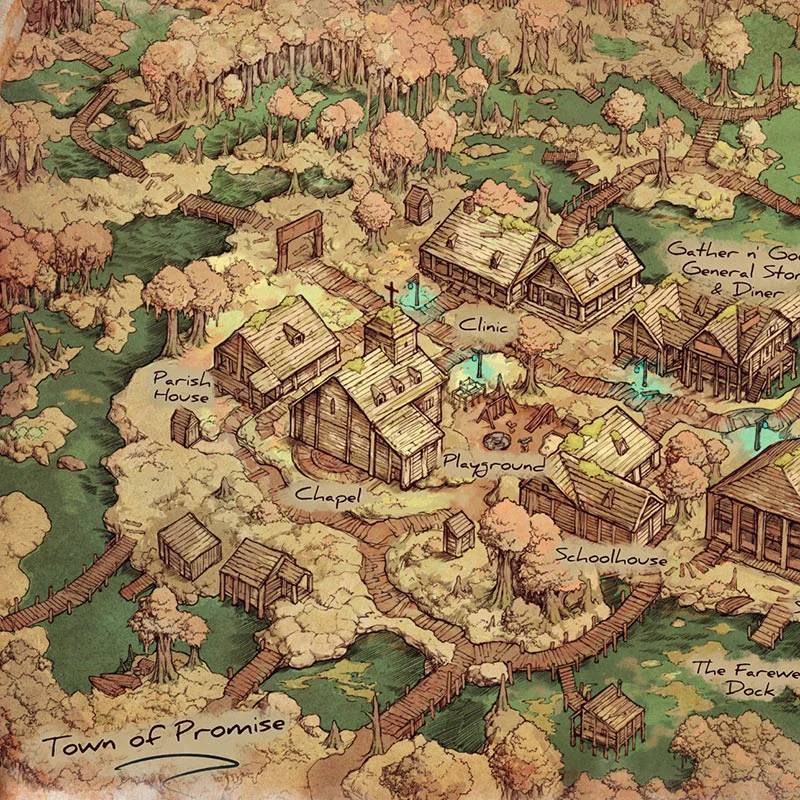
What makes a good battle map—great question. The answer is different depending on who you ask. For a game master, they need different aspects of the environment to work with in conjunction with the NPCs they’ll be using in that space. For players, they’ll want something that can spark roleplay ideas (like a sink in a warehouse, now the player has the idea to get a bucket of water to use against the enemy who is vulnerable to water).
In the early maps we made, some of the measurements surely ended up being a little wonky. We’ve tried to create both more general spaces that can be used across multiple scenarios and also make sure each battle map has a good amount of flavor. In a future article, Antonio Maínez Venegas, our art director, talks a bit about the illustration process in general which might be interesting to folks!

How do we create a whole interesting character on a single NPC card? That’s something we try to work on for each NPC. It helps that we can include information in the adventure booklet, too, of course. For some NPCs, like named ally characters, we include a backstory on one side with the aim to give the game master a good feeling of the personality and background of the individual. The art is also really important, and a good amount of work goes into writing art briefs/descriptions and working with our art director, Antonio Maínez Venegas, to get the characters looking right. A picture really says a lot.
I also try to name knacks, weaknesses, and even weapons in a flavorful way to give the game master more to work with. The knacks and weaknesses are super important to infuse with the personality of the character while keeping in mind what other NPCs might be in the scene.
KRK: Without spoiling too much, what inspired the story, characters, and the rest of your work in Welcome to Promise?
LBH: So I am a big fan of horror, thrillers, science fiction, mysteries, and suspense media. Specifically, I really love the concept of the shows Lost (created by Jeffrey Lieber, J.J. Abrams, and Damon Lindelof) and From (created by John Griffin). I was fascinated by the idea of making a scenario where you’re trapped somewhere and in this place the rules are different. My dad, Shaun, had a saying he came up with when he was a kid that stuck around—NRDNA, meaning Normal Rules Do Not Apply. I take that to heart when I create both at Edge and in my personal life— art can be anything you want it to be, and it doesn’t have to be done one way or another, art and the creative pursuit is yours to make it as you wish.
Don’t worry, we don’t change all of the mechanical rules or anything. But this place the investigators find themselves in definitely operates differently than what they’re used to, and they’ll need to figure out how to survive and complete certain tasks to find a way out. The way we designed this place gives the players a limited area they can interact with and gave us the opportunity to do more with that area and give that area more detail than we might be able to do if an adventure had the standard risk of players wandering off into the distance at any given moment. I only wish I could have done even more with Promise, but it did need to be a realistic size for a starter set!
I also took inspiration from my research into creole culture, Louisianian voodoo and its history, and a certain albino cryptid!
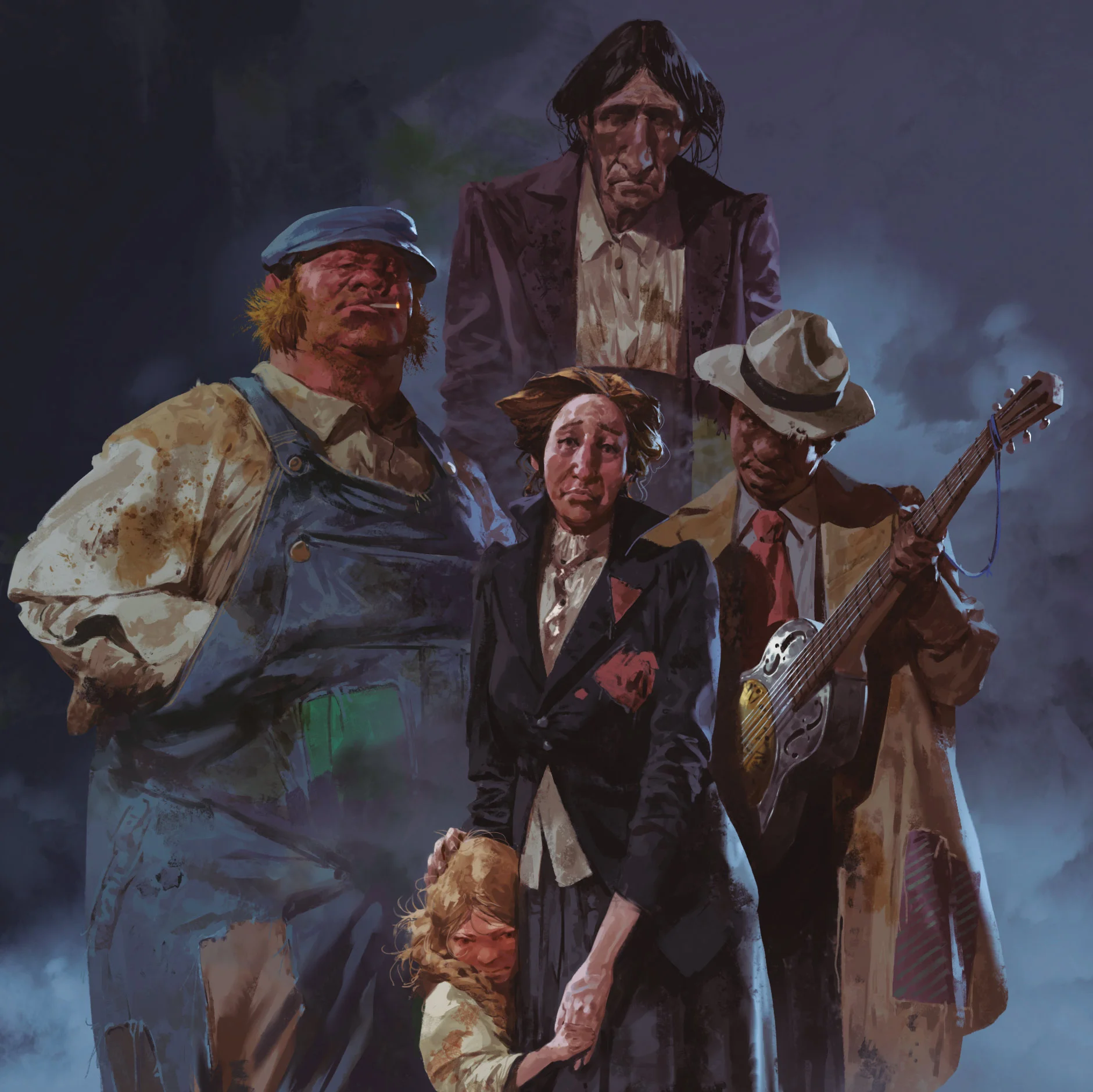
KRK: The players in Welcome to Promise get to take on the roles of five iconic investigators from the Arkham Horror universe, and incredibly, one of them has a dog! “Ashcan” Pete Washburne is one of the five investigators, and his dog Duke is present and features in one of his special abilities. He’s joined by Marie Lambeau, Jim Culver, Preston Fairmont, and Minh Thi Phan as they try to unravel the mysteries of Welcome to Promise.
What led you to choose these five specifically? What makes them work as a group?
LBH: The process of choosing which investigators to include in a product is also a really intensive process! We try to balance several factors when deciding who to use and ask several questions to slowly make a pool of possible candidates and then narrow the pool down to the final selections. Some of the questions we ask ourselves are (typically in this order):
- Does this character have a backstory tie-in we can use, like a regional connection? If not, can we create one that is plausible?
- Have we already used that character? If so, is there another character that would fit equally as well that we haven’t used before?
- How does this group of investigators work together, both from the perspective of roleplaying and how they’ll function mechanically? What archetypes make sense for this character? Do they have a diverse set of personalities?
- Are we doing our due diligence to best represent a demographically diverse group of characters?
As for the specific characters in Welcome to Promise, we started with being certain that we wanted both Marie Lambeau and Jim Culver, who both have ties to New Orleans. Knowing we wanted those two characters for sure, we went through the investigator roster with Marie and Jim (and their archetypes) in mind.
For reasons I won’t get into (to avoid spoilers!), Minh Thi Phan was also an easy choice. At that point we had two types of musicians and a seeker on the roster, we wanted a character more geared towards melee combat. During a meeting someone suggested “Ashcan” Pete and Duke, and the deal was sealed then and there! The idea of being able to give Duke his very own NPC card (and level-up options) was super exciting. “Ashcan” Pete gave us a guardian-type character to work with, plus a furry companion who’s favorite thing is being with his buddies and biting bad guys!
After that we had a pool of a few different investigators we could use for the final member of the team, and we came to the conclusion that Preston Fairmont was the best choice. We had an easy way to tie him into the adventure (he has a very fancy car and owed Marie big-time) and helped round out our team as a more flexible character with both social knacks and ranged combat ability.
KRK: Quick follow up! When you find yourself with a chance to play, which investigator are you most excited to play as, and why (obviously, I’m taking “Ashcan” Pete)?
LBH: Well I would definitely want to pick “Ashcan” Pete and Duke, but since you’re picking them…I think I’d genuinely really enjoy playing Marie Lambeau. She uses some new knacks for the musician archetype (which you’ll learn more about in a future product!) that are pretty fun. Shout out to Sam Gregor-Stewart for his work on those!
But, if I’m completely honest, I’m usually the game master at my table. And when I’m not, I like to let everyone else pick their characters first, because I’ll have fun with just about anything. I think part of the joy of being a player for me is trying to step into the shoes of a character and bring them to life with my own flair. So I’d be happy with playing any of the characters in Welcome to Promise, because each of them has their own unique “thing” they have going on which would be interesting for me to explore.
KRK: Okay, last question! When can players find the Welcome to Promise starter set for Arkham Horror: The Roleplaying Game at their friendly local game store?
LBH: Welcome to Promise releases July 31 of this year! I’ll also mention that folks attending GenCon this year in Indianapolis will be able to sign up for a demo of the product and pick up a copy on-site! I’ll even be running some of the games and be at the check-in desk regularly, so please come say hello—I love meeting all of Arkham’s curious investigators.
Well, you heard it here first, folks! It sounds like you can pick up the brand-new starter set soon! And after you’ve played through Welcome to Promise, you should check out all the other Arkham Horror: The Roleplaying Game products and the free demos and resources available on edge-studio.net ! Until then, keep your feet dry and stay in the blue light! –Keith Ryan Kappel
Arkham Horror RPG – Welcome to Promise – Starter Set will be released on July 31!